Crispy Development
CrispyDevelopment
Sign inSign upGet Started

Team Pathway

Lead a team that actually knows each other.

Two to ten people. Every member gets a full Personal account, and together you work through the Team Growth Journey. Everyone takes the assessments and reads each module on their own phone. You see the whole team in one place, and your weekly meeting starts where the reading left off.
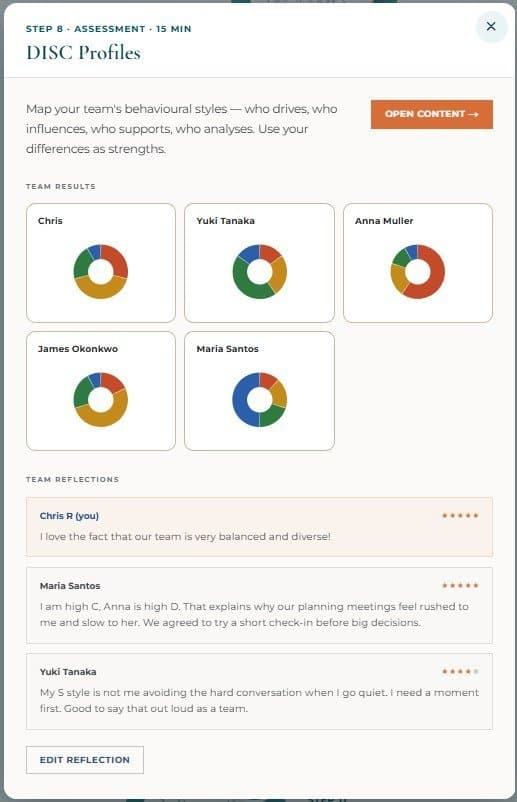
The team view: every member's assessment results side by side, so the whole team can see how it is wired before the next hard conversation.

Why a team account

Personal growth is good. Growing together changes how the team works.

When one person reads about trust or conflict, they learn something. When the whole team reads the same module in the same week, they get a shared language. "That was a process conflict, not a relationship one" becomes something anyone on the team can say. In multicultural teams this matters even more, because people arrive with different defaults about silence, disagreement, hierarchy and feedback. A team account gives everyone the same starting point, and gives the leader a clear view of who is on the team.

  • A full Personal account for every team member (2 to 10 people): their own dashboard, the complete library and all eight personal assessments
  • Every member's assessment results in one leader view
  • The Team Growth Journey, written for team development and built for weekly meetings
  • One payment, permanent access

See your team clearly

Every member's results, in one place.

Each member takes up to eight assessments. As team leader, you see all the results side by side instead of guessing from memory or a conversation two years ago. You can see why one person needs time to think before a decision while another wants to talk it through right away. You can see who feels valued by a word of thanks and who feels valued when you give them time. You can see where the team is strong and where there is nobody at all. It helps you place people well, prepare hard conversations, and stop reading difference as difficulty.

Members know their results are shared with the team before they join. Openness is part of the agreement.

Wheel of Life
Where each person is thriving or stretched right now
Enneagram
What drives each person, and what they do under pressure
5 Languages of Appreciation
How each person actually receives thanks at work
DISC
Pace, directness and working style across the team
Three Thinking Styles
How people process ideas and reach conclusions
16 Personalities
Energy, attention and decision preferences
Big Five (OCEAN)
A research-based picture of core personality traits
Spiritual Gifts
How God has equipped each person to serve the team

The team pathway

The Team Growth Journey. One conversation each week.

Short readings and hands-on workshops, in order. Each one ends with something the team does together, and several save their results straight to your team dashboard.
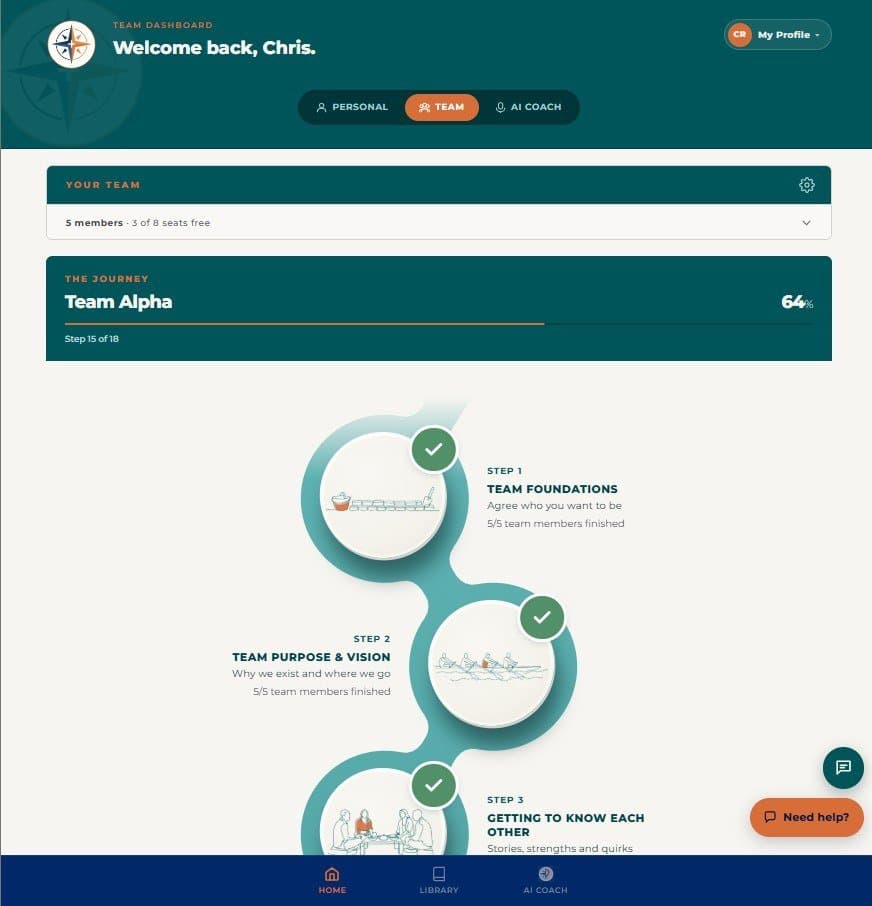
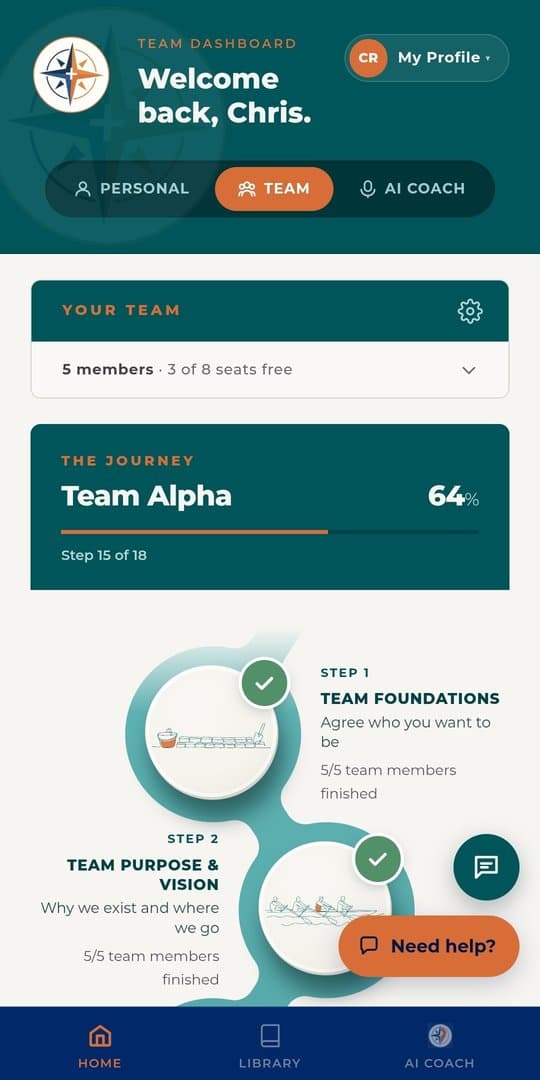
The Team Growth Journey: every step in order, with how many of your team have finished it.
  1. A group becomes a team when three quiet questions are answered: Do I belong? Do I matter? Is it safe to be honest here? This module shows why safety comes before sharpening, and why foundations have to be built together instead of copied from one culture. Your team leaves with shared language for what it needs, and a leader who sets the floor.

  2. Most teams assume they share a "why". Often they don't, and those different reasons quietly pull in different directions. In this four-stage workshop the team works through why, what, how and together, names three values it will actually keep, and writes one purpose statement: "Our team exists to... by... so that...". The finished statement is saved to your team dashboard.

  3. Knowing facts about a colleague is different from knowing them. This module looks at why being known feels risky, how culture shapes what people will share, and why the leader has to go first. The team gets 24 question cards across three levels of depth, and builds a simple habit: one question at every meeting, week after week.

  4. On a multicultural team, silence can mean agreement, disagreement or respect. This module explains high- and low-context communication and four styles: Architect, Diplomat, Connector and Analyst. Each member takes a 12-question assessment, saved to the dashboard. The team then says its norms out loud and builds feedback channels that work for every style, not only the loudest.

  5. Research from Google and Amy Edmondson points the same way: teams do their best work when people can admit mistakes without fear. This module covers what breaks trust, where shame gets in across cultures, and simple practices like thanking the person who brings bad news. The team completes a Trust Temperature Check across six areas, and the resulting profile is saved.

  6. What someone was hired to do and what they were made to do are often two different things. Using four Contribution Zones (Pioneer, Builder, Connector, Deepener), each member finds their zone and the team maps everyone side by side. Gaps become visible. In cultures where people rarely name their own strengths, the team learns to name them for each other.

  7. Conflict carries information, and avoiding it costs more than facing it. This module separates task, relationship and process conflict, shows how culture shapes each one, and gives the team a five-step PAUSE framework to use in the moment. A short quiz shows whether each person tends to protect, address or facilitate, so the team knows how the others will react.

  8. Trust wears down fastest when people don't know how a decision is being made. This module sets out three modes (directive, consultative and consensus) and what breaks each one, such as asking for input on a decision that was already made. The team works through six real scenarios, then commits to naming the mode, closing the loop and reviewing big decisions afterwards.

  9. A real commitment has three parts: what, by when, and to whom. This module looks at why people over-promise to keep the peace, how hierarchy and shame make it hard to report a slip, and why the leader must be the most accountable person in the room. The team adds a five-minute commitment round to each meeting and writes a shared Team Commitment.

  10. Before moving on, the team stops to see how far it has come. This last module is about celebrating progress and staying together over the long haul when differences have not gone away. The team writes a four-sentence Team Declaration, the kind of line that says "we are different, and we choose each other anyway", and asks what the next season should hold.

How it works

A rhythm that fits a busy team.

No extra training days. The reading happens before the meeting, so the meeting can go deeper.

  1. 01

    Read

    Each member reads the week's module on their phone, in their own time and at their own pace.

  2. 02

    Respond

    They leave their input and comments, so quieter voices are heard before anyone is in the room.

  3. 03

    Prepare

    The leader sees the team's input next to the module's teaching, and knows where the real conversation is.

  4. 04

    Meet

    At the weekly meeting everyone has read the same thing. Nobody needs a summary, so the team can discuss it properly.
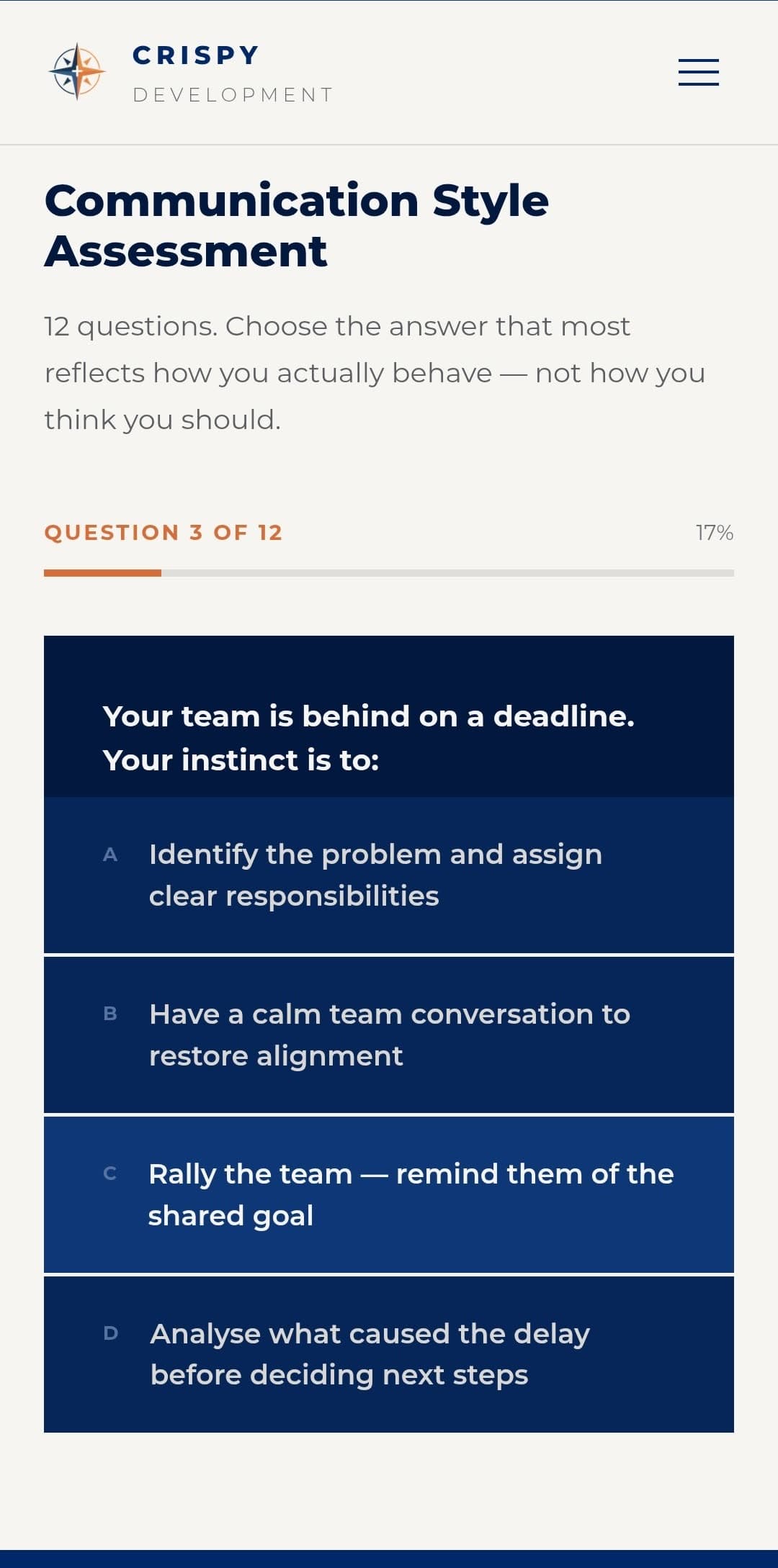
Respond: They leave their input and comments, so quieter voices are heard before anyone is in the room.
Prepare: The leader sees the team's input next to the module's teaching, and knows where the real conversation is.
Every module reads comfortably on a phone, and many come with their own team assessment. Done on the commute, between meetings, or at home in the evening.

Bring your whole team along.

Every person on your team gets a full Personal account: their own dashboard, the complete library of 50+ modules and all eight personal assessments.

On top of that, your team gets the Team Growth Journey, written for team development, to shape how your team works together and the culture you build.

Personal is $15. Team is $20 per person. The extra $5 adds the Team Growth Journey, the shared team results and your leader dashboard. For 2 to 10 people, paid once, with permanent access.

Set up your team